I Print Every Dose On The Label. Here's The One That Made Me Nervous.
"Falling asleep was never the problem. Staying asleep is." I've read some version of that sentence more times than I can count.
It arrives with remarkable consistency, and it always describes the same night.
Lights out at half past ten. Asleep in minutes, no trouble at all. Then, somewhere between two and four in the morning, awake. Not groggy-awake. Properly awake, like a switch was thrown. Nothing caused it. No noise, no dream, no reason you could name if someone asked.

And then the part that actually does the damage — not the waking, but the ninety minutes after it. Lying still so as not to wake the person next to you, who is sleeping through it with no idea. Doing arithmetic. Four hours and twelve minutes until the alarm. Now three fifty. Running the next day in your head in the exact order you will fail to get through it.
By morning you're not sure whether you slept for six hours or three. What you are sure of is that the day is going to be difficult, and that this was the third one this week.
That's the pattern. I build a sleep supplement, so it's the pattern I've spent the last stretch of my life reading about, and it is the reason this page exists.
I went looking at what my own category sells for this
I'm the person behind Norrell. Not a lab, not a marketing department — one person, which is relevant mostly because it means nobody talked me out of writing this.
Before I finalised anything, I did the obvious thing and read the labels of the products already being sold to the people writing me those sentences. Not the ad copy. The panels.
Two things stood out, and one of them changed what I built.
The first was how much stays hidden. A striking number of sleep formulas list a "proprietary blend" — a single combined weight covering six or eight ingredients, with no individual amounts. You are told what is in it. You are not told how much of any of it. And there's really only one reason to withhold that number. If a company will not tell you how much of something is in a capsule, the usual reason is that the answer is not impressive.
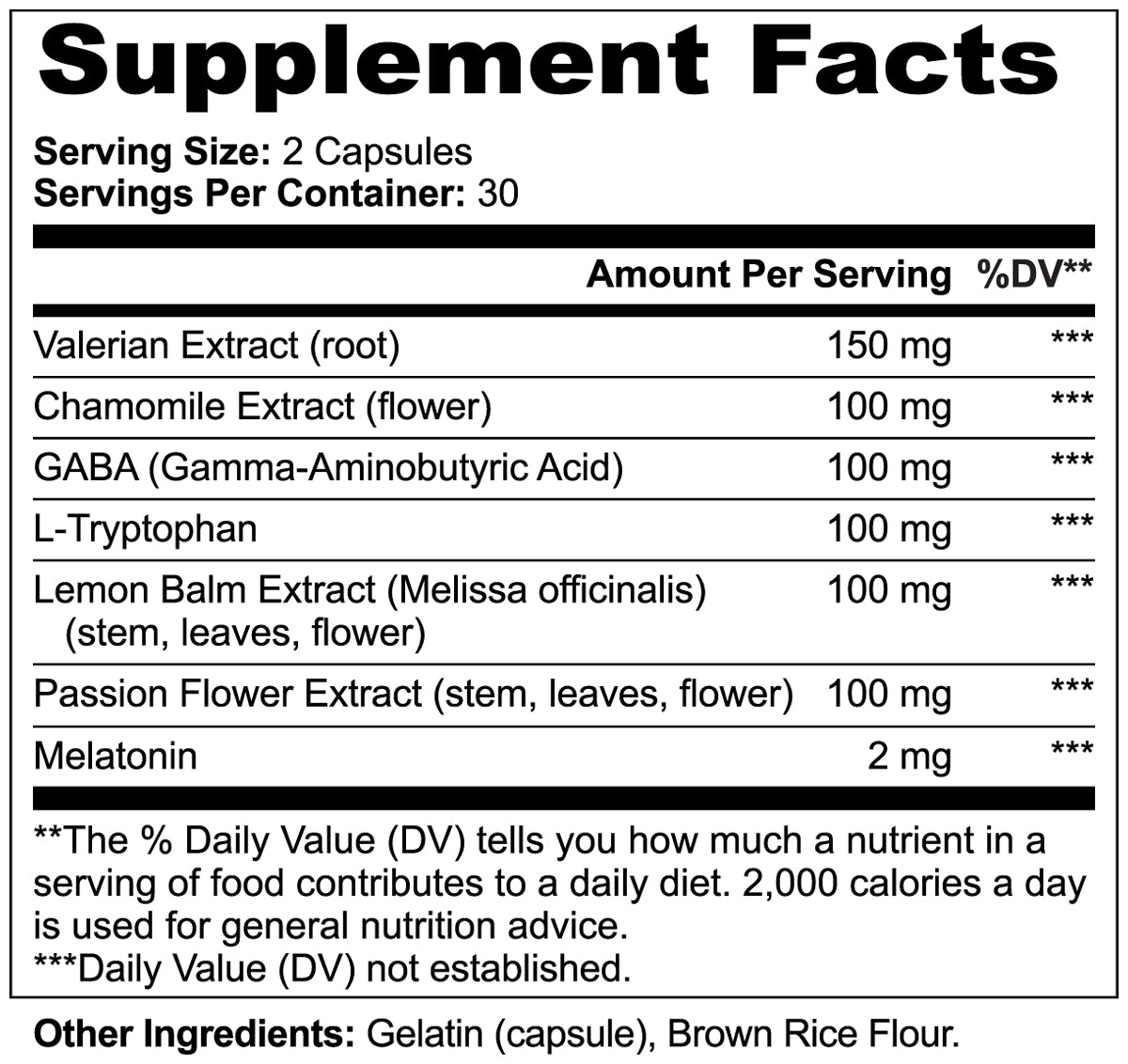
That one was easy to solve. I print all of it. Seven ingredients, seven numbers, no blends.
The second thing was harder, and it's the reason I'm writing rather than just running an ad.
The uncomfortable part
Melatonin is the ingredient this category leans on. It's in nearly everything, and it is very often the thing being sold, implicitly, as the answer to a three-in-the-morning problem.
So I read what melatonin is actually studied for.
In published research, melatonin is studied mainly in relation to the timing of sleep and the start of it. Its role in the back half of the night is considerably less well supported.
Read that against the night I described at the top of this page. You fall asleep without much trouble. Then you wake at three. The capsule's work sits at the front of the night. The part that bothers you is at the back of it.
That is an awkward sentence for someone in my position to write. It is also, as far as I can tell, true, and I'd rather you read it here — on the page where I'm asking for your money — than work it out yourself on night twelve and conclude you'd been sold something.
I sat with that for a while. There were two honest options.
One was to stop talking about the middle of the night entirely and sell a product for falling asleep, which is a real problem, just not the one filling my inbox.
The other was to accept that a capsule is one input, find out what actually moves the back half of the night, and build that half too.
I built the second one.
What actually moves the middle of the night
It isn't glamorous, which is presumably why nobody advertises it.
The back half of the night responds to a small number of unfashionable things: a wake time held seven days a week, including the Saturday you don't want to; ten minutes of outdoor light shortly after getting up; a wind-down that is a real ninety minutes rather than a phrase; and — the one almost everyone skips — what you do in the twenty minutes after you surface at 3am.
That last one is worth a sentence on its own, because it's counterintuitive. The waking itself is ordinary; nearly everyone surfaces several times a night. The problem is what happens next. You register that you're awake, you check how long is left, and you begin working at getting back to sleep. The working is the part that keeps you up. Effort and sleep don't combine — sleep arrives when attention is elsewhere, and the harder the attempt, the further off it gets.
The fix is mechanical rather than motivational, and it takes repetition. Which is why it takes weeks, not nights.
So the product is two things
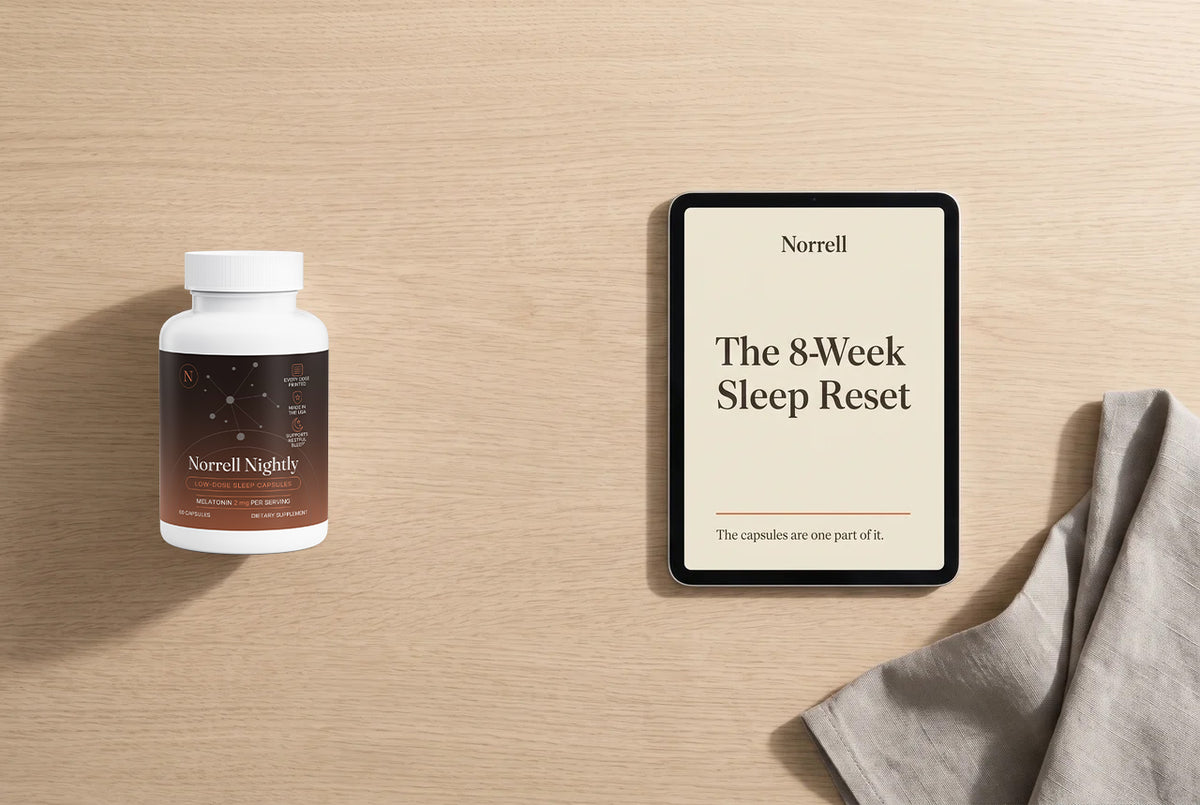
Norrell Nightly Sleep Capsules — two capsules, thirty servings, taken 30 to 45 minutes before lights out.
Two milligrams of melatonin per serving. Six botanicals and amino compounds alongside it — valerian, chamomile, GABA, L-tryptophan, lemon balm, passion flower — each with its exact amount printed. Seven ingredients, seven numbers, no proprietary blends. Made in the USA in a facility following current Good Manufacturing Practices.
The 8-Week Sleep Reset — a 34-page routine, free with two bottles or more. Fifty-six nights, one change per fortnight: the wake time, then the wind-down, then the middle-of-the-night rule, then a fortnight to hold it and see what's left. Log sheets in the back, because memory of sleep is unreliable and biased toward the worst night of the week.
The plan runs 56 nights. One bottle is 30 servings. Two bottles is the supply the plan requires — that's the whole reason the second bottle exists, and it's arithmetic rather than a discount.
The capsule accompanies the routine. That's the honest description of the arrangement, and it's printed inside the guide as well as here.
Every amount printed. No proprietary blends.
What the eight weeks actually look like
I'd rather set this out plainly than let you measure it against an expectation nobody could meet.
Nights one to three. The most common report is a modest change in how long it takes to drop off, and nothing else. A good number of people notice nothing at all. Both are ordinary and neither is a verdict. What almost nobody gets in three nights is a changed 3am — that's a pattern, and patterns don't move that fast.
Week one. The wake time goes in, and week one commonly feels harder than the week before it, for a plain reason: a fixed Saturday rise time removes sleep that used to get made up at the weekend. That cost is real, it's front-loaded, and it's paid once.
Weeks two to four. This is where the middle of the night usually starts to move, and it's easy to miss, because most people watch the wrong column. The change is rarely fewer wakings. It's usually shorter ones. Waking at 3am and going back down in twelve minutes is a completely different night from waking at 3am and lying there for ninety — and both get recorded as one waking. Watch the minutes.
Weeks five to eight. What people describe here is quieter than what they imagined at the start. Very few report sleeping straight through. The more common description is: you wake, you notice, you go back down, and by morning you're not sure how long it took. The waking stops being an event.
And the part I'm contractually obliged to no one to include: some people reach week eight with a pattern that has not shifted at all. Section 11 of the guide is written for exactly that case, and it does not tell you to try harder or buy more. It tells you what to bring to a doctor, and what to say.
What a good result looks like
Your nights get boring.
That's the honest version. There's no morning where you wake up feeling like a different person, and if you're holding out for one as proof, you may hold out well past the point where things have already improved.
The gains are cumulative and slightly dull. A shorter wake-up. An easier Sunday. A week where you didn't think about your sleep much at all. The reason for changing anything about the night is the next day — which is why the log sheets ask you to score the day, not the night.
The 8-Week Reset is included free with two bottles.
The 8-Week Reset is included free with two bottles.
The morning after is the thing people quit over
That's the part that ends most attempts. Not the night — the morning. Something got taken at ten, and by eight the next day the head is thick and the first two hours are gone, and the bottle goes in a drawer with the others.
The number in the capsule has a lot to do with that, and in most products the number is not printed anywhere a person could find it. A blend weight covering six ingredients tells you nothing about any of them.
Mine is two milligrams of melatonin. It's on the panel, on the bottle, on the product page, and in the guide. Four places, same number. You don't have to take my word for any of it — not taking my word for it is the entire point of printing it.
So the next page opens with the label. Not a promise, not a testimonial — the panel, all seven amounts, and then everything I'd want to know before swallowing something: what's in the capsule shell, what it interacts with, when to take it, and what the eight weeks actually ask of you.
If the arithmetic holds up, it's there to buy. If it doesn't, you've lost four minutes and you know one more thing about how this category labels itself.
Every dose printed.
The 8-Week Sleep Reset is included free with two bottles. The Stress Test, covering weeks nine to twelve, with three. Both tiers carry the 56-Night Guarantee — the length of the plan itself.
These statements have not been evaluated by the Food and Drug Administration. This product is not intended to diagnose, treat, cure, or prevent any disease.
This page is for general educational purposes and is not medical advice. Consult your physician before starting any supplement, particularly if you are taking prescription medication or have an existing health concern. Not for use by anyone under 18, or by women who are pregnant or nursing. Do not drive or operate machinery after taking this product.
Norrell — trynorrell.com · support@trynorrell.com